
The History of Option Trading
From ancient olive presses to modern trading floors, options were created to manage uncertainty, not to chase quick profits.
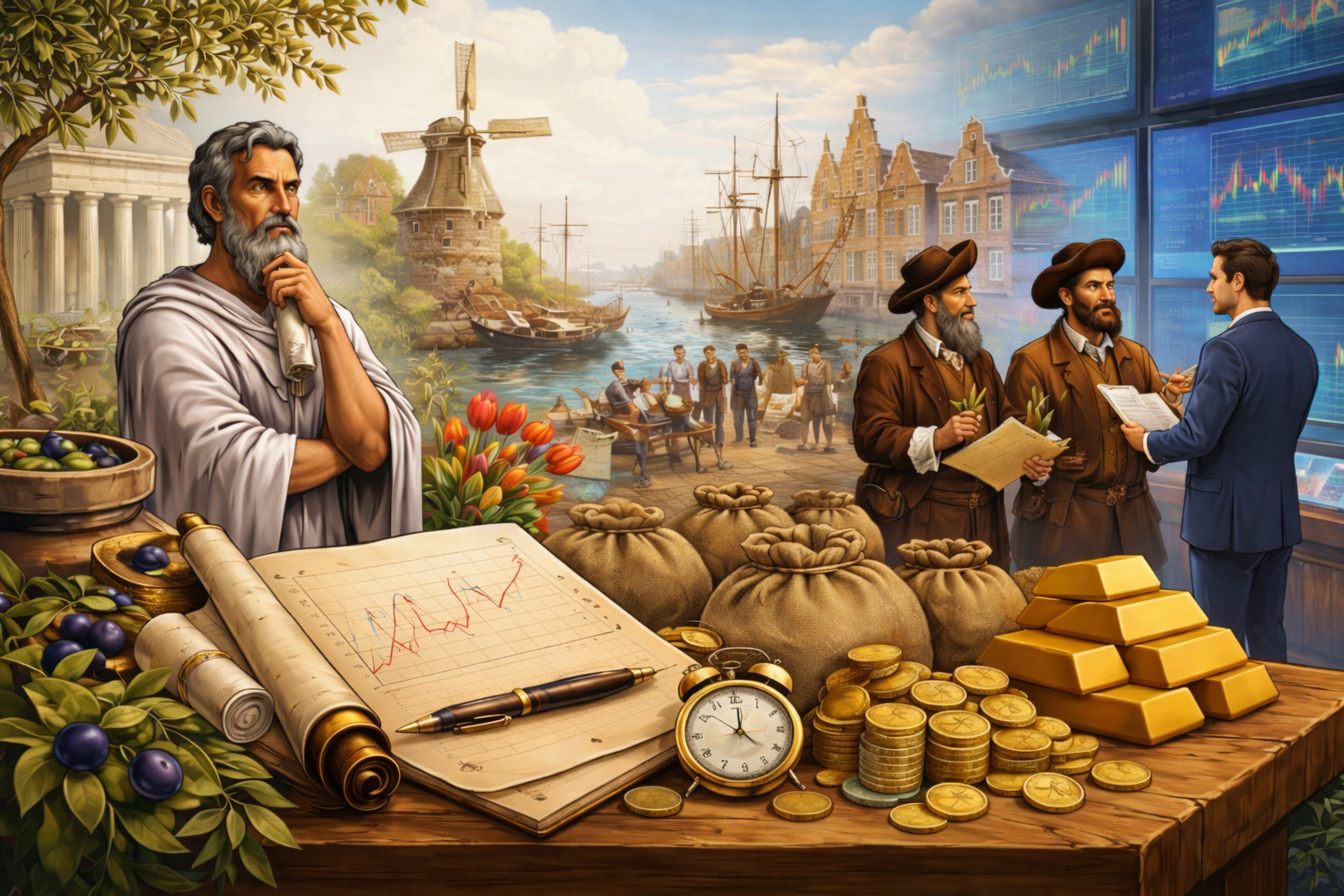
Today, options trading is often associated with fast money, flashing screens, and dramatic wins or losses. But originally, options were far more practical, and surprisingly human. The earliest known example comes from ancient Greece, where the philosopher Thales of Miletus made a quiet, calculated bet on the olive harvest around 600 BCE. Instead of buying olive presses outright, he paid a small fee for the right to use them later if his prediction proved correct. When the harvest turned out to be abundant, demand for presses soared and Thales profited. Aristotle later wrote about this story not as speculation, but as proof that knowledge and foresight could be used to manage uncertainty.
As trade expanded across Europe in the 1600s, merchants faced the same problem people still face today: the unpredictability of the future. Prices of goods could swing wildly depending on weather, wars, or shipping delays. Options quietly became tools that helped traders ease their anxiety regarding their business investments. In the Netherlands, during the Dutch Golden Age, options were commonly used to hedge price risk in commodities and early company shares. Even during the much-misunderstood Tulip Mania, options were largely mechanisms to limit losses, not reckless bets for instant wealth. The idea was simple, pay a small amount now to avoid a potentially devastating loss later.
Options truly entered the modern financial world in 1973 with the creation of the Chicago Board Options Exchange (CBOE). For the first time, options contracts were standardized, regulated, and openly traded. That same year, the Black–Scholes model gave traders a mathematical way to price uncertainty, something markets had always struggled with. This was not about chasing lottery-like returns. It was about making markets more stable, predictable, and fair for investors managing large sums of money.
At heart, options were designed to work like insurance. A farmer hedging crop prices, an investor protecting a retirement portfolio from a market crash, or a company managing currency risk were all doing the same thing, accepting a small known cost to avoid a large unknown loss. Even popular strategies like covered calls were meant to generate steady income while holding long-term investments. As the Options Clearing Corporation explains, options exist to transfer risk from those who want protection to those willing to take it.
Over time, technology changed behaviour. Online trading, zero commissions, and ultra-short-term contracts turned options into tools for speed and speculation. While there is nothing inherently wrong with speculation, it is worth remembering that options were never built for adrenaline-fueled bets. They were created to bring calm to chaos, to help people navigate uncertainty with structure and foresight. Understanding that original purpose can change not just how we trade options, but how we respect the risks they carry.