
The AI Cold War Between NVIDIA and China
Nvidia’s battle to sell AI chips in China is no longer just a business story, it is a geopolitical tug-of-war shaping the future of the global AI market.
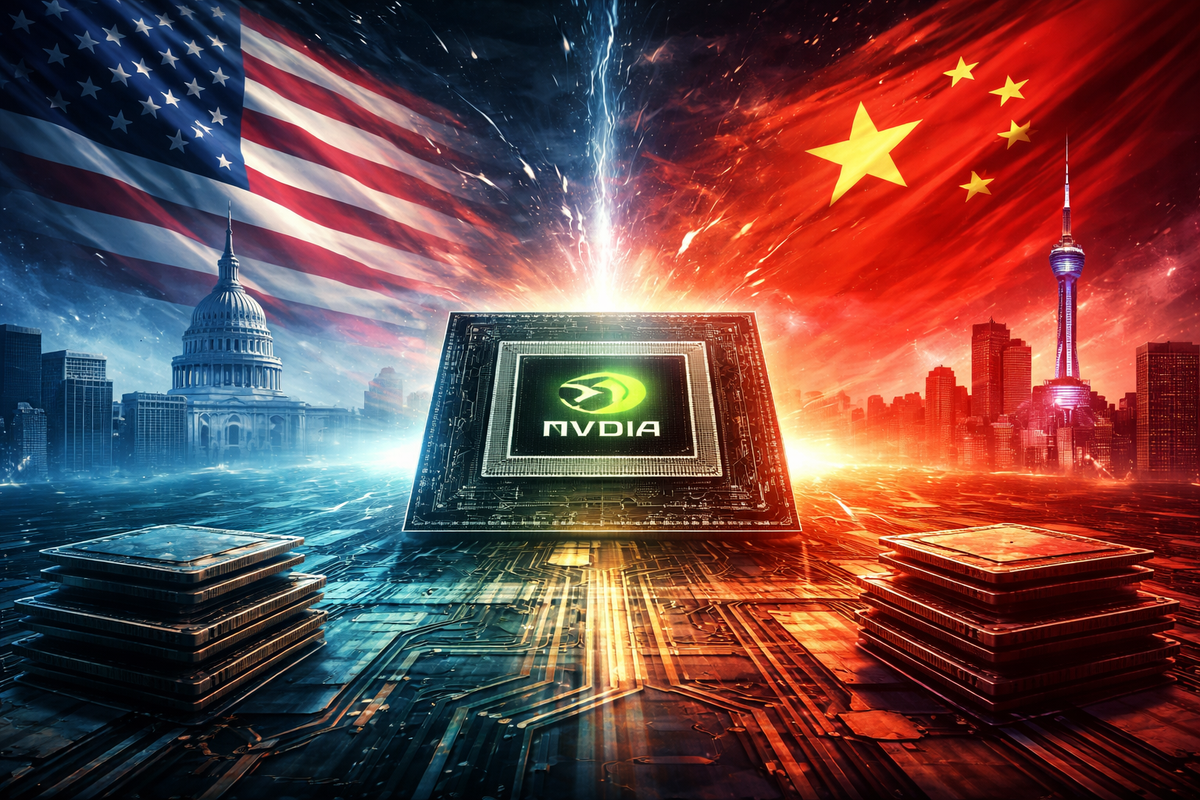
Nvidia’s relationship with China has quietly become one of the most important fault lines in the global AI boom. For years, U.S. export controls kept Nvidia’s most powerful chips out of Chinese data centres, even as China’s tech giants raced to build AI models that rival OpenAI and Google. These restricted exports were due to national security concerns that such technology could boost China’s military capabilities and enable advanced AI systems that rival U.S. leadership, reflecting fears that powerful computing hardware can be repurposed for defence and intelligence applications. That wall began to crack in early 2026, when Washington approved limited exports of Nvidia’s H200 AI chip to China under strict conditions, including monitoring and security assurances. The decision was widely seen as an attempt to balance national security with economic reality: China is simply too big an AI market for U.S. firms to ignore.
But politics does not end at the border. Even after the U.S. gave its blessing, Chinese customs authorities reportedly blocked some H200 shipments, throwing a wrench into what was supposed to be Nvidia’s return to one of its most lucrative markets. The situation grew tense enough that Nvidia’s CEO Jensen Huang flew to Shanghai to personally engage with regulators and partners. According to Reuters, suppliers in China even halted production of key H200 components after customs officials raised objections.
China is one of the world’s largest markets for AI semiconductors, with demand estimated in the tens of billions of dollars and accounting for a significant portion of global AI compute growth. Historically, China was a significant contributor to Nvidia’s sales, accounting for roughly 13–17 % of the company’s total revenue before tightened export restrictions, with annual China revenue being around $17 billion. Export bans on key AI chips have led to billions in lost revenue; Nvidia reported write-downs and missed sales opportunities, having recorded a loss of approx. $8 billion.
In the short term, this back-and-forth is creating both hope and whiplash for the AI market. Chinese tech companies are eager to get their hands on Nvidia’s newest chips, and reports suggest massive pent-up demand once shipments resume. If exports stabilize, analysts believe Nvidia could unlock billions in incremental revenue over the next year or two. At the same time, every new regulatory snag sends tremors through supply chains and stock markets, reminding investors that geopolitics, not just product cycles, now shape the AI hardware business.
The long-term story is even more complicated. China is pouring enormous resources into building its own AI chips, from Huawei’s Ascend line to startups like Biren and Cambricon. Even if Nvidia regains partial access to the market, Beijing’s strategic goal is clear: reduce reliance on U.S. technology altogether. That means Nvidia’s dominance in China may never fully return to what it once was, and the global AI ecosystem could slowly split into two parallel worlds, one built around Nvidia’s CUDA platform and another centred on China’s homegrown hardware and software stack.
If Nvidia is locked out of the Chinese AI market due to export bans, it could result in billions of dollars in lost revenue and reduced global scale for U.S. AI hardware companies, potentially weakening U.S. chipmakers’ competitive edge and slowing investment in next-generation AI infrastructure. Such restrictions may also accelerate China’s development of domestic AI hardware, reducing reliance on U.S. technology and eventually diminishing the influence of U.S. AI standards and platforms globally, which could fragment the broader AI ecosystem.
In the end, Nvidia’s China dilemma captures a deeper truth about the AI revolution. The technology is global, but the politics are not. In the short run, every headline about export approvals or blocked shipments will continue to swing sentiment around Nvidia and the broader AI sector. In the long run, the bigger risk is not lost sales, it is a fractured AI market where innovation, standards, and supply chains increasingly follow geopolitical lines rather than purely economic ones.