
Follow the Flow: The Secret Rhythm of Global Markets
Capital never truly leaves the market, it simply rotates between stocks, bonds, commodities, and crypto, chasing safety in fear and growth in confidence.
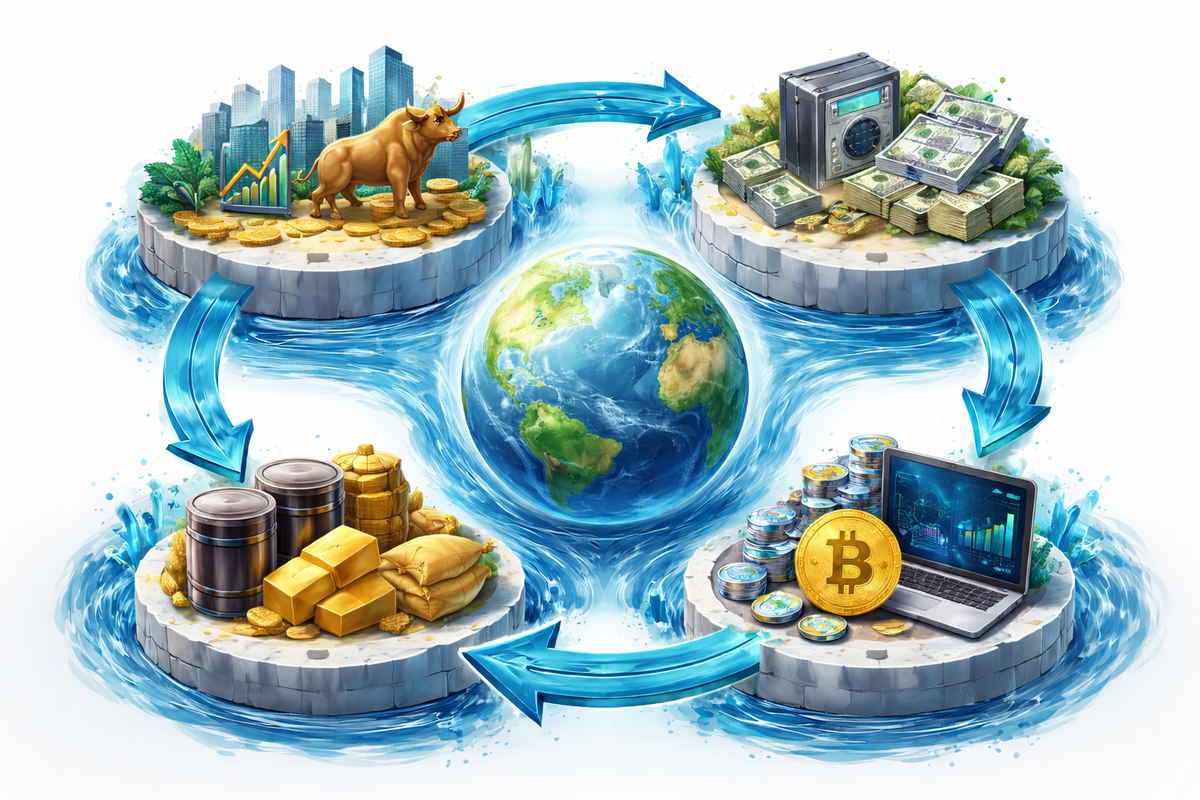
If you watch markets long enough, you start to notice something: money does not disappear but rather it just moves. It slips quietly out of one asset class and shows up somewhere else, like water finding the lowest point. When investors feel confident, it rushes into stocks and crypto, chasing growth. When nerves kick in, it retreats into bonds or gold for safety. These constant shifts, known as capital flows, are what really drive market cycles beneath all the daily noise. Prices change because money changes its mind.
In good times, when interest rates are low and central banks are supportive, risk feels cheap. Borrowing costs drop, businesses expand, and investors start stretching for higher returns. That is usually when equities get the first wave of inflows. After the pandemic, for example, massive stimulus and near-zero rates helped ignite one of the fastest stock market rallies in history, something the Federal Reserve’s policy response itself documents. The IMF has also shown how easy money tends to spill into global equity markets as investors hunt for growth. When cash is abundant, optimism spreads fast, and stocks are usually the first beneficiaries.
But the mood flips quickly when uncertainty creeps in. Suddenly, returns matter less than protection. That is when bonds, especially U.S. Treasuries, become the financial equivalent of a safe harbour. During crises like 2008 or the early days of COVID, huge sums flowed back into government debt as investors simply wanted stability, something reflected repeatedly in U.S. Treasury market data. It is not exciting but defensive money.
Commodities follow a different rhythm. They tend to shine when inflation bites or supply chains break down. If oil gets scarce or food prices spike, investors start looking for real, tangible assets that hold value. The World Bank’s commodity outlook reports regularly highlight how energy and metals attract capital during these periods. Gold, especially, becomes emotional insurance, something people buy not because they expect explosive growth, but because it helps them sleep at night. In 2020 (during the COVID-19 market stress), global inflows into gold-backed exchange-traded funds reached 877.1 tonnes of gold, roughly US $47.9 billion worth, the highest annual total on record according to the World Gold Council.
Then there is crypto, the wild child of the group. Unlike gold, it does not usually act as a shelter. Instead, it behaves more like a turbocharged tech stock, soaring when liquidity is everywhere and tumbling when it disappears. After the pandemic market downturn, the total cryptocurrency market cap expanded massively, growing from about $757 billion in 2020 to roughly $2.32 trillion in 2021, more than tripling in size in one year. Research from Fidelity Digital Assets shows how closely Bitcoin now moves with broader risk assets. In many ways, crypto sits at the far end of the risk spectrum, the place money goes when investors feel bold and leaves first when fear returns.
Put it all together and you start to see the pattern: bonds for safety, stocks for growth, commodities for inflation and crypto for speculation. Capital is always rotating between them depending on the mood of the economy. And once you recognize that rhythm, markets feel less random. They feel human, driven by the same emotions we all have: fear, hope, and the constant search for something better.