
Code Over Capital: The Hidden Battle in Layer-1 Blockchains
Layer-1 competition ultimately determines long-term winners not by speed or cost, but by which ecosystems attract and retain the most developers.
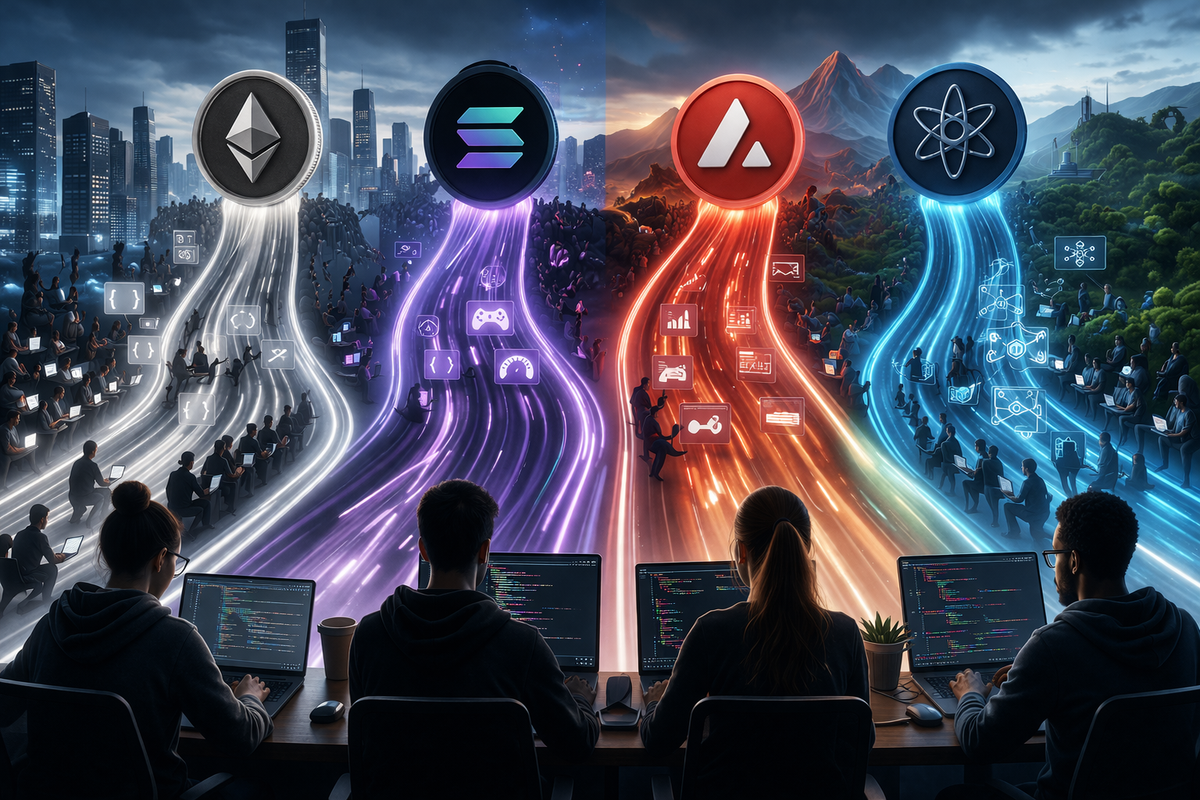
Competition among layer-1 (L1) blockchains such as Ethereum, Solana, Avalanche, and Cosmos is often framed around throughput and fees, but the more consequential battle is for developers. Over time, developer ecosystems, not token prices, determine which chains endure. According to the Electric Capital 2023 Developer Report, the number of active developers is one of the strongest leading indicators of long-term ecosystem success, with Ethereum still maintaining the largest share despite rising competition.
In the short term, L1s aggressively use capital to attract developers. Solana’s ecosystem growth, fuelled by grants and accelerator programs, is frequently cited in reports like the Crypto Theses 2024. Similarly, Avalanche launched its multi-million dollar incentive programs to bootstrap DeFi and gaming ecosystems. While these strategies drive rapid onboarding, data suggests that incentive-driven growth is often cyclical, with developer activity declining once subsidies taper off.
Over longer horizons, network effects dominate. Ethereum continues to benefit from a deeply entrenched ecosystem of tools, standards, and liquidity. The State of Ethereum report 2023 highlights how composability and EVM standardization create a “developer flywheel,” where existing infrastructure attracts more builders, which in turn strengthens the ecosystem. This dynamic explains why many competing chains have adopted EVM compatibility to tap into Ethereum’s developer base rather than compete with it directly.
At the same time, L1 competition has accelerated improvements in developer experience (DX). Solana’s Rust-based environment prioritizes performance and parallelization, while Cosmos emphasizes modularity through its appchain model, as outlined in the Cosmos Whitepaper. These architectural differences shape how developers design applications—whether leveraging shared liquidity in a monolithic chain or building sovereign chains optimized for specific use cases.
Ultimately, L1 competition is driving a shift from fragmented experimentation toward selective consolidation around ecosystems with durable fundamentals. While multiple chains will coexist, only a few will sustain deep developer communities over time. As consistently shown in the Electric Capital 2023 Developer Report, ecosystems that combine strong tooling, active communities, and real user demand are far more resilient than those reliant on short-term incentives. In the long run, the outcome of L1 competition will not be decided by technical benchmarks alone, but by which platforms succeed in becoming the default environments where developers choose to build.