
Can the AI Bubble Burst?
AI’s promise is real, but soaring valuations, massive infrastructure costs, and macro risks are raising early warning signs of a potential bubble.
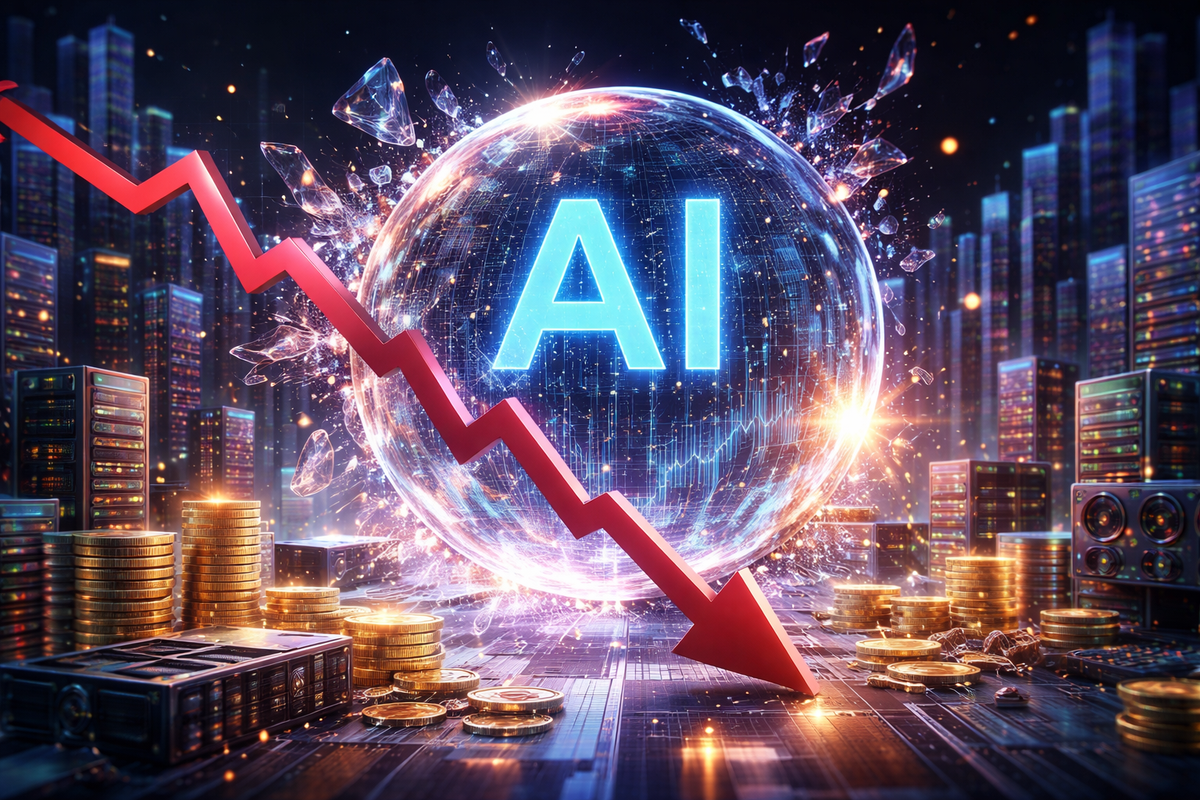
Artificial intelligence feels a bit like the internet did in the late 1990s, full of promise, excitement, and the belief that everything is about to change overnight. Investors are pouring billions into AI companies, from chipmakers to software start-ups, all chasing the next breakthrough. The AI sector’s overall market value has ballooned from just a few billion dollars in the early 2020s to an estimated North American AI market size exceeding $50 billion by 2025, with rapid growth seen across chips, data services, healthcare, finance, and more. Even seasoned market veterans are impressed by the technology, but some are beginning to raise a quiet red flag. Ray Dalio, founder of Bridgewater Associates, recently said the AI boom is showing early signs of a bubble, not because AI isn’t powerful, but because expectations may be racing ahead of reality.
One of the biggest risks is valuation disconnect. Many AI-driven companies are priced as if future success is already guaranteed. Stocks tied to AI narratives often trade at extremely high price-to-sales ratios, even when profits are minimal or non-existent. History shows this pattern that when investors buy stories instead of earnings, markets become fragile. If revenue growth slows or adoption takes longer than expected, prices can fall fast, as optimism gives way to realism.
Investment is not just flowing into software or models, infrastructure spending has reached unprecedented levels, and that brings its own risks. Tech giants like Microsoft, Google, Amazon, and Meta are collectively committing hundreds of billions of dollars annually to AI infrastructure, data centres, chips, power systems, and cooling facilities. In some projections, AI infrastructure alone may exceed $400 billion in annual spending, adding up to nearly a trillion dollars over just a few years. Thus the issue stems that AI is incredibly expensive to build and run. Training large models requires vast amounts of computing power, electricity, and specialized hardware. Analysts have pointed out that while demand for AI services is exploding, the physical infrastructure such as data centres, power grids, and chip supply can’t expand overnight. These bottlenecks delay profits and strain balance sheets, especially for smaller companies without deep pockets.
Macroeconomic conditions could also play a huge role in bursting the AI bubble. AI stocks thrive in an environment of cheap money, but higher interest rates make speculative investments less attractive. Economist Ruchir Sharma has warned that the AI frenzy shows classic bubble traits: heavy capital concentration, excessive optimism, and rising leverage. If central banks stay cautious or tighten policy further, money could quickly flow out of high-growth AI names.
Finally, trust and regulation matter more than many investors assume. High-profile AI failures, hallucinations, bias, copyright disputes, or misuse, can slow adoption just as quickly as hype accelerates it. At the same time, governments are beginning to scrutinize AI’s impact on jobs, data privacy, and national security. Recently highlighted concerns show that massive AI spending could even contribute to inflation, forcing policymakers to step in sooner than markets expect.
This pattern is reminiscent of the dot-com bubble, when companies with minimal or no revenue were valued as if profits were already assured. During that era, many firms traded on “eyeballs” rather than actual earnings, and today some AI startups trade at revenue multiples far higher than typical tech businesses, driven more by investor enthusiasm than fundamental cash flows. Even though many large tech companies integrating AI do generate significant revenue, the broader picture shows a disconnect between investment dollars and proven business results, a classic early warning sign that markets may be overheating.
If an AI bubble does burst, it won’t mean AI failed. More likely, it would mark a reset, where unrealistic expectations fall away, weaker players disappear, and truly valuable companies remain. Just like the dot-com crash cleared the path for giants like Amazon and Google, an AI correction could ultimately strengthen the industry by grounding it in real-world value rather than unchecked hype.
*Disclaimer: The post is simply designed to educate individuals about assets and their workings. The platform does not endorse any specific asset and does not provide financial or investment advice.