
Automation, Algorithms, and the Future of Operating Leverage
AI and automation are quietly reshaping corporate margins by boosting productivity, improving decision-making, and enabling scalable business models that decouple growth from labour costs.
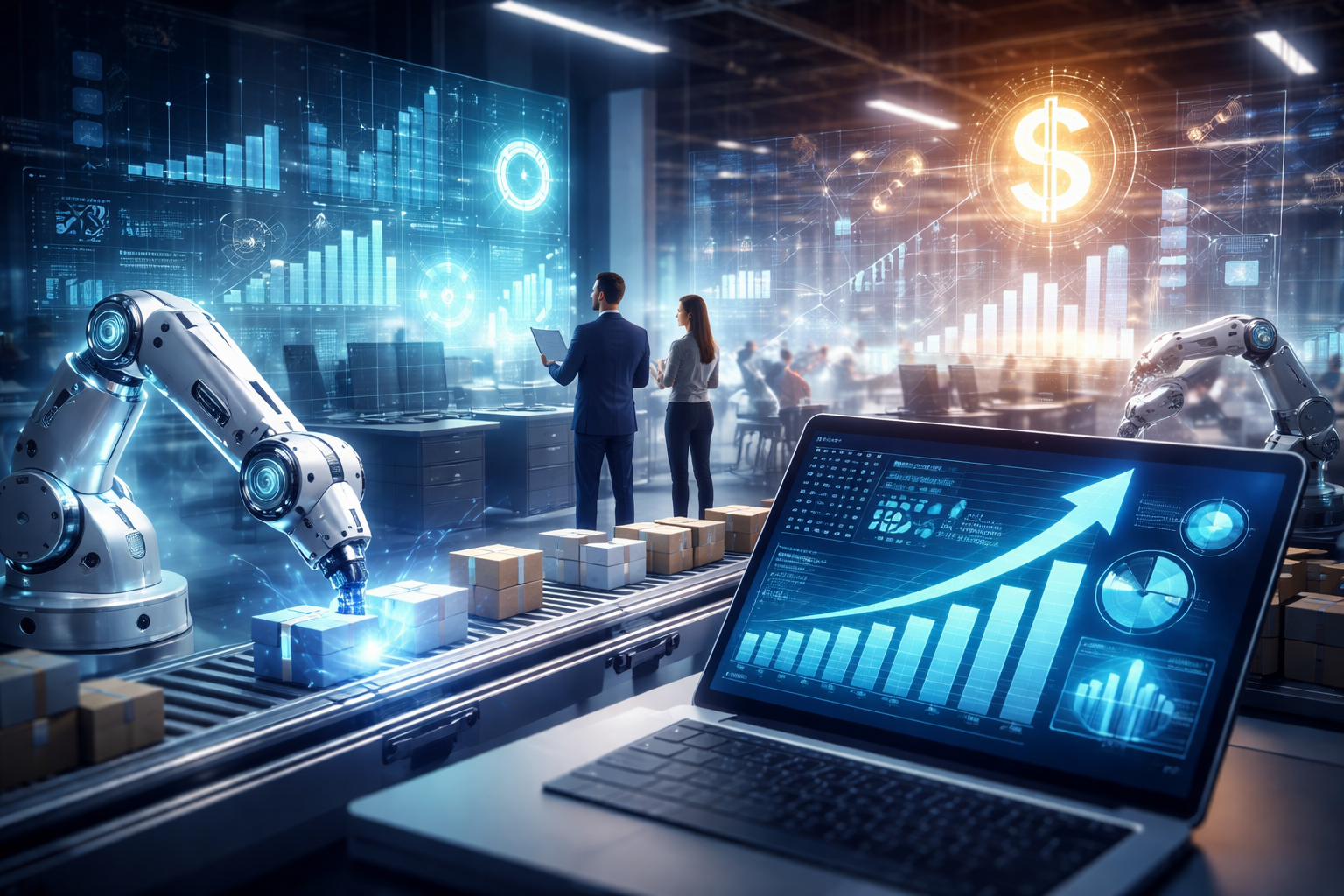
Artificial intelligence and automation are no longer abstract tech themes, they are steadily reshaping how companies protect and expand their margins. At a human level, the shift is simple: businesses are trying to grow revenue without growing headcount at the same pace. Over time, that decoupling of output from labour costs can structurally lift operating margins.
One can see this clearly in logistics. Amazon has spent billions on robotics and AI across its fulfilment centres. The company’s growing robot fleet has helped reduce fulfilment costs per unit while increasing delivery speed. Meanwhile, research from McKinsey & Company estimates that AI could add trillions of dollars in productivity gains globally, much of it through automation of routine work. When productivity rises faster than wage costs, margins tend to widen.
Microsoft, Alphabet, Amazon and Meta Platforms together are directing hundreds of billions of dollars toward data centres and AI infrastructure, pushing depreciation and capex intensity so high that free cash flow and margins are squeezed, slowing buybacks and dividends. AI spending intensity varies across the group, while Apple’s capital expenditures remain relatively modest, many of its peers are consuming 60–90 % of operating cash flow on AI-related capex, which trims near-term profitability until revenue growth from those investments materializes.
Financial services offer another example. JPMorgan Chase developed an AI system called COiN to review commercial loan contracts in seconds, work that once took lawyers thousands of hours. Bloomberg reported on this transformation and said that the margin impact is not just labour savings; it is also lower error rates and faster deal processing. Over time, better underwriting, fraud detection, and pricing algorithms reduce losses and improve return on equity, subtle but powerful drivers of sustained profitability.
Analysts expect that massive AI investments by firms like Microsoft, Amazon, Alphabet and Meta will drive double-digit revenue growth in cloud and AI-linked services over the next several years, with cloud units (where AI is central) growing at 30%+ annually and helping offset high capex with scalable returns. Long-term investor theses suggest that these AI bets could unlock substantial shareholder value by expanding high-margin AI revenue streams (e.g., AI cloud, ads optimization, chips) and establish durable competitive moats, although the precise timing of return on this capex remains debated.
If you want, I can point to specific company guidance (e.g., Nvidia, AWS, Azure growth forecasts) to quantify the expected returns more precisely.
However, AI comes with heavy upfront costs. Companies are pouring capital into chips and cloud infrastructure, benefiting firms like NVIDIA. Leading news journals have reported on this, noting the enormous surge in spending on AI hardware and data centres. In the short run, these investments can compress margins. The gains only materialize if automation meaningfully improves efficiency or creates defensible competitive advantages.
Ultimately, the biggest long-term margin gains happen when AI does not just cut costs, it enables new revenue streams. As Harvard Business Review argues, companies that combine proprietary data, scalable algorithms, and platform ecosystems can build durable moats. When AI becomes embedded in products and services, it raises switching costs and pricing power , and that is when margins reset structurally higher rather than temporarily spike.
In that sense, AI and automation are not about replacing people. They are about redesigning cost structures, decision-making, and even business models. The firms that treat AI as a long-term strategic asset, not just a cost-saving tool, are the ones most likely to see sustained margin expansion over the next decade.